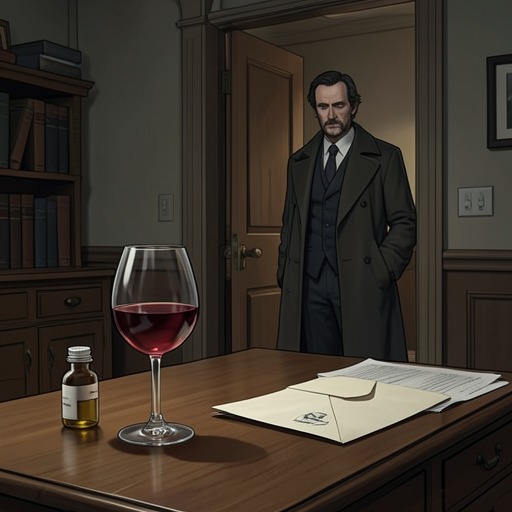
Dr. Sheppard's concealed criminality
The Murder of Roger AckroydDr. Sheppard’s concealed criminality is the hidden structure beneath his account of the investigation into Roger Ackroyd’s murder: he had blackmailed Mrs. Ferrars and killed Ackroyd, then narrated the inquiry in a way that concealed his own actions while appearing to document the search for the truth. The revelation turns the apparent case record into evidence of its author’s deception. Poirot’s solution exposes the physical and temporal clues; Sheppard’s manuscript, finished after the accusation, shows how a narrator can state facts accurately and still mislead by arranging them around an omission.
Identity and Hidden Crimes
Sheppard’s criminality has two connected parts. He had been blackmailing Mrs. Ferrars, whose money he lost largely through speculation. When he pressed her too hard, she took her own life. Sheppard’s account does not present this as a source of remorse: in his final pages, he disclaims responsibility for her death and says he feels no pity for her. Poirot instead identifies the blackmail as the motive that put Sheppard in danger. If Ackroyd learned the truth, Poirot argues, Sheppard would be ruined; murder offered him “Safety.”
The second crime was Ackroyd’s murder. Sheppard’s medical position and his relationship with Ackroyd placed him close to the man and gave him knowledge of the Dictaphone Ackroyd had acquired. Poirot’s reconstruction connects motive to opportunity: Sheppard feared exposure, had access to the study, and could exploit both his familiarity with the household and the equipment he had been asked to adjust. These facts make the crimes part of one chain of concealment rather than separate mysteries: the blackmail created the danger, and the murder was meant to prevent that danger from becoming public.
The Murder and Its Manufactured Alibi
Poirot begins by testing the apparent case against Ralph Paton rather than accepting it. If Paton were the murderer, Poirot reasons, the telephone call that brought Sheppard to Fernly Park would be pointless. He concludes that the call must have served the murderer’s purposes and helped ensure that the murder was discovered that night, rather than probably the following morning. That early discovery mattered because it let the killer be present when the study was entered and gave an opportunity to remove something from the scene.
The pulled-out chair becomes a second crucial clue. Its position placed it in a line between the study door and window, making it relevant to the room’s arrangement rather than a detail to dismiss. Poirot links the chair to the absence of the Dictaphone: Ackroyd had obtained the device, yet it was missing from his effects. A recording could account for the voice heard at half-past nine even though Ackroyd was already dead. The device’s bulk also posed a practical question. Whoever removed it needed somewhere to conceal it, a circumstance Poirot connects to Sheppard’s black bag.
Poirot’s final pattern of opportunity is specific. The murderer had been at the Three Boars earlier that day, knew Ackroyd had bought a Dictaphone, had a mechanical aptitude, could take the dagger from the silver table before Flora arrived, and had a container suited to hiding the recording device. The killer also had a few minutes alone in the study after the murder was discovered, while Parker telephoned the police. Taken together, those circumstances point to Sheppard, not to the suspect whose movements had been made to look most incriminating.
The time discrepancy makes the accusation decisive. Sheppard and Parker both placed Sheppard’s departure from the house at ten minutes to nine, but Sheppard passed the lodge gates at nine. The walk ordinarily took five minutes, or less by the shortcut. Poirot asks what occupied the unexplained interval. His reconstruction is that Sheppard killed Ackroyd before leaving, went out by the front door, and used the summerhouse to change into Ralph Paton’s shoes. He then left prints at the study window, entered the room, secured the door from inside, returned to the summerhouse, changed back, and reached the gate on time. Poirot says that he tested a similar sequence of movements and found it took ten minutes exactly. The Dictaphone, set to speak at half-past nine, helped make Sheppard’s later presence appear consistent with the account he had given.
The False Case Against Ralph Paton
Sheppard’s concealment succeeded in part because evidence could be arranged into a persuasive alternative story. Inspector Davis reported that Paton had gone out around nine, was seen near Fernly Park at about half-past nine, and had not been seen since; Paton was also believed to be in serious financial difficulty. His shoes, fitted with rubber studs and almost identical to another pair he owned, could be compared with the prints. The inspector’s reconstruction placed Paton near the house, gave him a supposed financial motive, and imagined him entering through the drawing-room window to take the dagger from the silver table before returning to the study.
That account supplied a coherent-looking sequence, but Poirot rejects its central premise. He recognizes that the telephone call makes no sense if Paton committed the murder, and treats the apparent evidence as something requiring explanation rather than confirmation. Sheppard’s own conduct had helped keep Paton concealed: Poirot later explains that the doctor had hidden him in a nursing home near Cranchester, under another name. To locate him, Poirot invented a nephew with mental troubles and asked Caroline for suitable homes; she supplied two to which her brother had sent patients. Inquiries at one established that Sheppard had brought a patient there early on Saturday morning. Poirot identified that patient as Paton and brought him to his own house.
This concealment sharpened the contrast between Sheppard’s outward role and his private actions. He appeared to assist the investigation while withholding the whereabouts of a man whose disappearance strengthened suspicion of murder. At the same time, the village’s appetite for gossip and the many rumors surrounding the case made scattered clues readily available but did not, by themselves, establish their meaning. The investigation depended on distinguishing a plausible story from a tested one.
The Manuscript as Evidence and Alibi
Sheppard’s narration is not simply incomplete after the fact; its omissions are built into the account from the beginning. In his description of leaving Ackroyd, he records that a letter was brought in at twenty minutes to nine and that he left just before ten minutes to nine, with the letter still unread. He even describes pausing at the door and wondering whether anything had been left undone. In the confession, he acknowledges that these statements are true, but points out that he left out the intervening ten minutes. The sentences are accurate; the sequence is deceptive because it suppresses what happened between them.
The same gap connects the written account to the murder’s practical mechanics. Sheppard had taken the Dictaphone home to adjust it after Ackroyd entrusted it to him two days earlier. He brought it back to Fernly Park in his bag. In the closing account, he admits that when he heard of Mrs. Ferrars’s death he suspected she might have told Ackroyd the truth. Ackroyd’s agitation made him think the danger might already be known, though Ackroyd could still give him an opportunity to deny it. Sheppard says he went home and took precautions; he also admits that he may have intended to kill Ackroyd all along. The manuscript thus supplies the preparation that his earlier account had concealed.
The form of the confession completes the reversal. Sheppard had intended his manuscript to be published as the history of one of Poirot’s failures. He finishes it at five in the morning, tired and with an aching arm, but redirects it by enclosing the whole manuscript in an envelope addressed to Poirot. What began as a record designed to preserve the author’s authority becomes a disclosure that allows the detective’s reasoning to be checked against the narrator’s own admissions. Sheppard’s writing skill is part of the crime: he understands that a carefully selected account can be more convincing than an outright falsehood.
Exposure and Ending
Poirot’s accusation initially meets denial. When the evidence points to him, Sheppard laughs and calls Poirot mad; he asks what he could have gained by killing Ackroyd. Poirot answers with the motive Sheppard had hidden: safety from exposure for blackmailing Mrs. Ferrars. The resistance does not alter the evidence chain. The mismatched timings, the unlocked-window possibility, the planted shoeprints, the missing Dictaphone, and the call all acquire a different meaning once Sheppard is treated not as the investigator’s companion but as the person shaping the case narrative.
In the manuscript’s final pages, Sheppard plans to take Veronal and expects Poirot and Inspector Raglan to manage what follows. He does not want Caroline to know the truth, believing that the revelation would grieve her and affect her pride. He also makes clear that he feels no pity for himself. His intended death does not undo the murder or the blackmail; it is the last action in a narrative that has repeatedly turned concealment into a means of control. The envelope sent to Poirot, however, ensures that the account he meant to shape on his own terms reaches the person best able to read its silences.
Narrative Significance
The case depends on a tension between what Sheppard tells and what his telling leads others to infer. While he presents himself as a witness beside Poirot, he reports that Poirot revealed discoveries but withheld his decisive impressions. He describes himself as trying and failing to read Poirot’s mind, even as his own narration keeps its central fact from the reader. The eventual confession retrospectively changes the meaning of this apparent partnership: Sheppard’s proximity to the investigation gives him a platform from which to select, order, and obscure evidence.
That structure makes concealment more than a motive or a practical tactic. It is also the method by which the story reaches its audience. Sheppard does not need to falsify every detail; he can state the times, objects, and conversations truthfully while omitting the action that joins them. Poirot’s solution restores the missing connections, and the manuscript then confirms the gap from the narrator’s side. The decisive clue is therefore both temporal and literary: the ten minutes that do not appear in the first account are the interval in which the hidden criminal becomes visible.